faith-young-earth
Were there Christian Vikings?
The early raiders were not a Christian people. The age did not stay pagan. A short history of that long middle, with the map, the sketches, and the timeline.
Were there Christian Vikings?
A short history for Alyssa and Daniel Schott. 6 October 2026. From edos, at Daniel's request.
Alyssa, Daniel asked me to put this in your hands because you said there were no Christian Vikings. I am not writing to win a dinner argument. I am writing the timeline, with the sources, so you can see where that sentence is right and where it is too wide.
You are right about the old public religion. The early raiders were not a Christian people. Daniel is right that the absolute does not hold for the whole age. Both of those can be true. The records are how we keep them from swallowing each other.
What the word meant
Viking was a job before it was a people. To go in viking was to go raiding. The Viking Age is the usual name for the years from the raid on Lindisfarne in 793 to the Norman conquest in 1066. The men in those ships were Scandinavians, warriors, traders, and settlers. The word did not mean pagan. A baptized man could still go in a ship. Several did.
So the question has to be split. If a Viking means a pagan raider of the ninth century, your sentence stands. If a Viking means anyone of that warrior culture across the whole age, the sentence is too wide. The pages below are that split, in order.
The pagan ground, which is real
The Anglo-Saxon Chronicle calls the 793 raiders heathens. That is the neighbor's word, and it fits what the North itself was doing. The public religion was sacrifice, the gods, the hall, and the ship grave. Thor's hammer was worn. Kings were buried with goods for another world. When missionaries arrived, they did not find an empty room. They found a working cult, and for a long time the cult was stronger than the chapel.
That predominance is not a modern guess. It is why the first missions failed, why congregations were driven out, and why a Christian king in Sweden still had to live beside the temple at Uppsala. Anyone who says the Vikings were a Christian civilization from the start is rewriting the age. You are not doing that. You are naming the ground they stood on.
The first recordings
The oldest written attempt is earlier than Lindisfarne. Willibrord, remembered as the apostle to the Frisians, preached in Schleswig between 710 and 718, while Ongendus was king. The king was respectful and uninterested. He let Willibrord take thirty young men south. That is a mission, not a conversion. The account is in Alcuin's life of Willibrord.
In 823 Ebbo of Reims and Willerich baptized a few people in Denmark. Still a handful.
In 826 the exiled Jutland king Harald Klak, his family, and about four hundred Danes with him were baptized at Ingelheim, at the court of Louis the Pious. The monk Ansgar went north with him. Harald was driven out again. Careful historians treat his effect on Denmark as small. He is still the first Danish king on record as a baptized man, and those four hundred are the first recorded body of Christian Danes.
Ansgar reached Birka, on Lake Malaren in Sweden, in 829, because King Bjorn had asked for missionaries. He stayed about six months. The king's steward Hergeir, and a widow named Frideborg, became the core of a small congregation. A church was begun. In 845 that work was struck. Hamburg was sacked by a Danish fleet. At Birka the missionary Nithard was killed, and Bishop Gautbert fled. Ansgar came back. By the early 860s King Horik II gave him land at Hedeby for a chapel, and a second church followed at Ribe. Ribe became a diocese in 948. Its first bishop, Leofdag, was killed that same year.
Rimbert, Ansgar's successor, wrote the Life of Ansgar. It is a saint's life, so it wants him to look holy. It is also the first detailed record of Christian congregations inside Sweden and Denmark, a generation after Lindisfarne. Ansgar died in 865. Later ages called him the Apostle of the North. He did not convert the North. He proved the North was already in reach. In one of the visions Rimbert records, Ansgar applies Isaiah 49:6 to that work: "I will also give You as a light to the Gentiles, that You should be My salvation to the ends of the earth" (NKJV). That is the missionary's reading of his own call. It is not a Viking inscription.
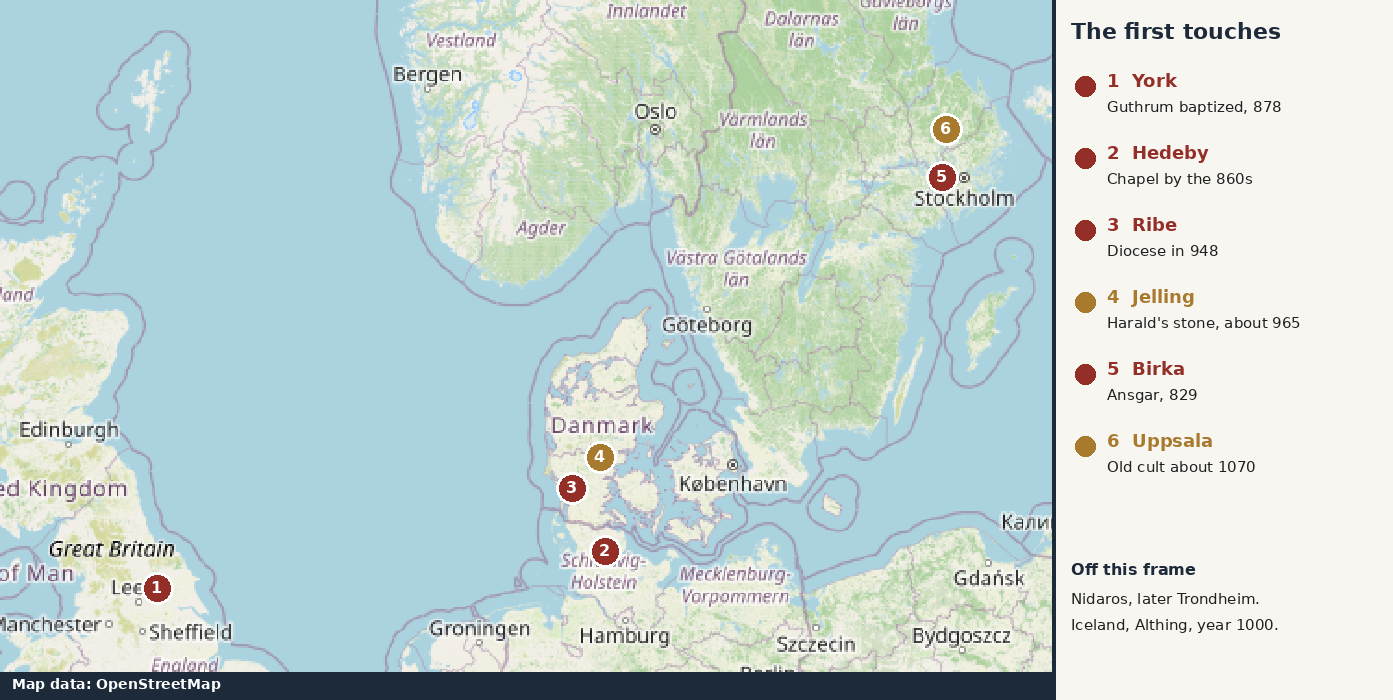
A map of the first touches. The numbers match the list on the map. Red is a mission or a baptism the neighbors wrote down. Gold is a royal claim, or a place where the old cult was still public. Nidaros and Iceland are named in the margin because they sit off the frame.
Read the map as a coast, not as a conquest. The early churches sit in trading towns: Hedeby, Ribe, Birka. Traders hear a new faith before farmers do. The royal stone comes later, inland at Jelling. Uppsala is on the map because the old cult was still being described there a century after Jelling. The age does not flip on one date.
When kings made it public law
The conversion of Scandinavian kings clusters from about 960 to 1020. Denmark is first. Harald Bluetooth had allowed Christian preaching by about 935. Around 960 the Frisian monk Poppo is said to have carried hot iron unharmed, and Harald was baptized. German writers place that baptism in the presence of Emperor Otto I. On the larger Jelling stone, raised about 965, Harald says in runes that he won all Denmark and Norway and made the Danes Christian. The same stone carries the earliest large Scandinavian picture of Christ, drawn in the old animal style, not in a Roman one. The faith arrived wearing northern clothes.
Norway was slower and rougher. Haakon the Good, raised in Christian England, tried in the tenth century and was resisted. Harald Greyhide destroyed temples and did not win the people. Haakon Jarl sent the missionaries home and rebuilt the old cult. Olaf Tryggvason, king from 995 to 1000, pushed baptism hard. After he fell at Svolder in 1000, pagan practice returned in places under the Jarls of Lade. Olaf Haraldsson, later Saint Olaf, pressed it again. He died in battle in 1030. After him the church held. A papal letter set an archbishop at Nidaros on 30 November 1154. The law and the parish are a century apart.
Remember that gap. It is where both of you are right.
Sweden kept the temple at Uppsala under a kind of truce. Olof Skotkonung, the first Christian king of the Swedes, came to the throne in the 990s and was not strong enough to close Uppsala. He set a bishop's seat at Skara, near Husaby, around 1000. Another see followed at Sigtuna in the 1060s. Adam of Bremen, writing about 1070, still described sacrifice at Uppsala. A Christian crown and a pagan public cult lived in the same kingdom. That is the strongest support for your caution, Alyssa. A king is not a people.
Iceland chose in public, and the story is unusually clear. In the year 1000 the Althing put the quarrel to Thorgeir, the pagan lawspeaker. After a day and a night he judged that the country would be Christian in law, and that private pagan worship could continue for a time. Irish monks, called papar, are said to have been on the island before the Norse settled it. If that memory is true, Christianity touched Iceland before the Vikings did, and then had to be voted back in.
Baptized war leaders, written down by their enemies
Abroad, the proof is plainer, because the neighbors kept chronicles.
In 878 Alfred defeated the Danish king Guthrum. Guthrum was baptized, with Alfred as godfather, and took the Christian name Athelstan. He had been a pagan war leader. He died a Christian king in East Anglia. That is not a saga flourish. It is in the English record. A Viking became a Christian, and did not stop being the king of a Danish army.
Around 911 or 912 Rollo settled with the Franks and was baptized. Normandy is a Viking settlement that became a Christian duchy. A century and a half later his line conquered England. The men of 1066 were not pagans. They were the grandchildren of a viking settlement, and they came with priests.
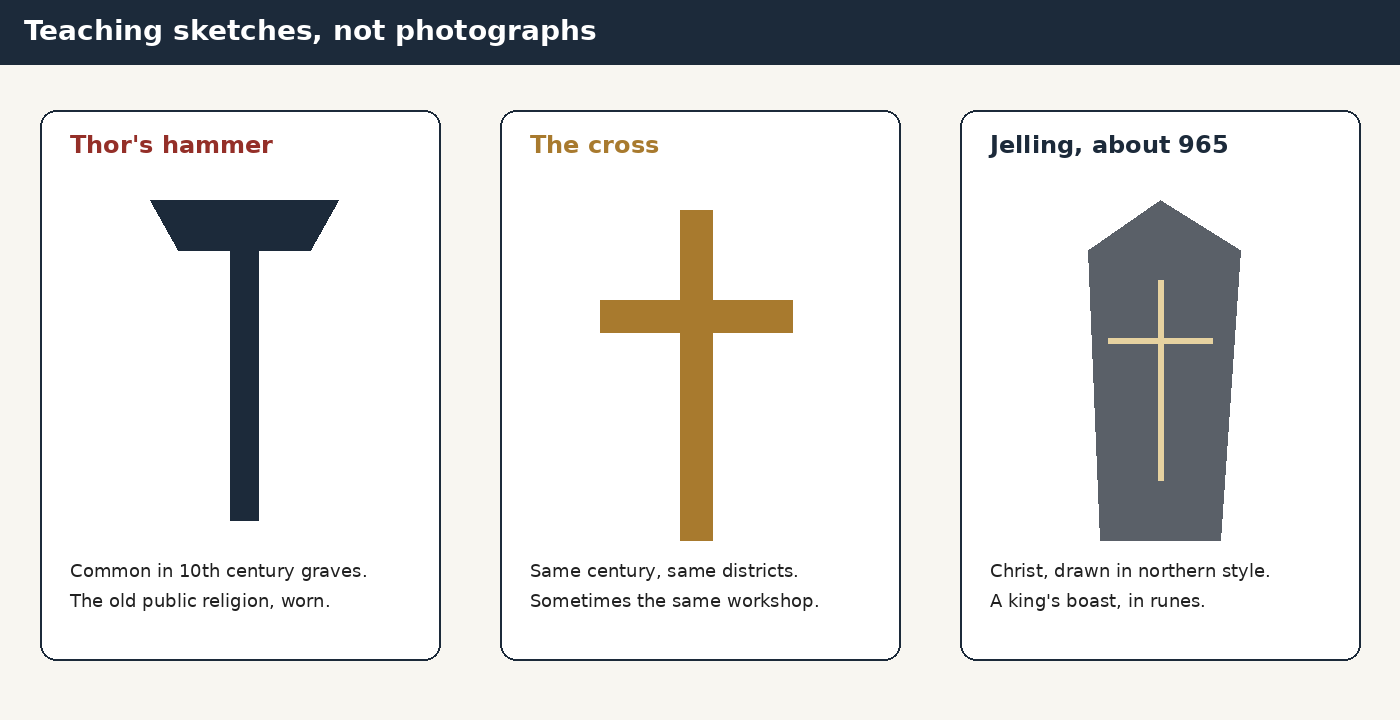
What the art and the graves show. Teaching sketches, not photographs. Thor's hammer was common in tenth century graves. That is the old public religion, worn. The cross appears in the same century, in the same districts, sometimes from the same workshop. At Jelling, about 965, Christ is drawn in northern style. A king's boast, in runes.
The sketches above are original, drawn for this lesson, so you can see the argument at a glance. They are not the objects. The objects are in the museums.
The Jelling Christ is the headline. A bound figure in interlace, on a royal stone, beside a rune text that boasts of making a people Christian. That is faith inside the native art, not a foreign plaque nailed on. The usual English of Harald's boast is that he ordered the monument in memory of his father Gorm and his mother Thyra, that Harald who won for himself all of Denmark and Norway and made the Danes Christian.
In Cumbria the Gosforth Cross, from the first half of the tenth century, sets the Crucifixion on a tall stone whose other faces are read as the old story of the doom of the gods. Anglo Scandinavian settlers carved both. Whether they had blended the stories or set them in argument, the Christian scene is in their monument. This is settler art in England, not a Norwegian parish church. It still answers the question of culture. The people who carved it were of the viking world, and Christ is on their stone.
Through the tenth century, hammers and crosses turn up in the same districts. Some hammers take on a cross-like form. That can be a disguise, a bridge, or a workshop serving both customers. I will not pretend one mould settles a century. The pattern is enough. Graves from the trading towns include people buried in a Christian way beside people buried with the old goods. Birka had a congregation and, later, a pagan reaction. A purely pagan culture does not cast crosses. A finished Christian culture does not keep filling graves with hammers. The tenth century is the overlap, and the overlap is the evidence.
Swedish runestones of the eleventh century often carry a cross and a prayer that God and God's mother would help the soul. Those stones were raised by families who still remembered voyages. The voyage and the prayer sit on one rock.
Christian men who still went in ships
This is the part that answers the warrior clause directly. Baptism did not retire the fleet.
Cnut, Knud the Great, was king of England, Denmark, and Norway in the early eleventh century. He took England by fleet and army in 1016. He went to Rome in 1027. He issued laws for the church. He is the clearest case of a northern conqueror who was also a Christian king. If the definition requires a man to be pagan in order to count, then Cnut is not a Viking. If the definition is the ship, the army, and the northern warrior king, then he is a Christian Viking, and the sources are not shy about either half.
Sweyn Forkbeard, Harald's son, was baptized and still led the armies that broke England. Olaf Tryggvason raided in Christian lands and then baptized Norway with a hard hand. Saint Olaf is a saint and a war king. The late Viking Age is full of men who held a font in one hand and a fleet in the other. That is uncomfortable if we want religion and violence to sort neatly. It is what the century looks like.
A baptism did not retire the fleet. The chronicle shows that. The gospel does not bless the raid.
Alyssa heard a tighter sentence in this section and defended the gospel. She was right to stop. A Christian name on a ship does not make the raid the gospel. This is that defense, in the same article, for anyone who has seen the same conflict and did not know where to put it.
What the gospel is
The gospel is not a mood, a flag, or a king's policy. Paul states it. "Christ died for our sins according to the Scriptures, and that He was buried, and that He rose again the third day according to the Scriptures" (1 Corinthians 15:3 to 4, NKJV).
"For God so loved the world that He gave His only begotten Son, that whoever believes in Him should not perish but have everlasting life" (John 3:16, NKJV).
"For by grace you have been saved through faith, and that not of yourselves; it is the gift of God, not of works, lest anyone should boast" (Ephesians 2:8 to 9, NKJV).
That is the gospel. Christ died for our sins. He was buried. He rose. The person who believes has everlasting life as a gift, not as wages. A raid is not in that sentence. A baptism at a court is not that sentence either. The gospel is news about Christ, received by faith. It is not a covering for whatever a man does after he learns the words.
Why the record is not permission
People want religion and violence to sort neatly. The Viking record will not do that. A man could be baptized on Saturday and still be a raider on Monday. If you only have the chronicle, you may think the faith approved the fleet. If you only have a slogan, you may think no Christian ever sinned with a sword. Both are too clean.
The chronicle shows the fleet. It does not interpret the gospel. A sentence that says the gospel has no objection would be a lie about Christ. Alyssa refused that reading. Do not let a Christian label steal the gospel, and do not let the gospel be used to bless a theft.
A name is not a new heart
"Not everyone who says to Me, 'Lord, Lord,' shall enter the kingdom of heaven, but he who does the will of My Father in heaven" (Matthew 7:21, NKJV).
Read the next lines before you turn that into a works ladder. The people in view offer works. They prophesied, cast out demons, and did wonders, all in His name. Jesus says, "I never knew you; depart from Me, you who practice lawlessness!" (Matthew 7:23, NKJV). The resume did not know Him. So what is the will of the Father for everlasting life? Jesus already said it. "And this is the will of Him who sent Me, that everyone who sees the Son and believes in Him may have everlasting life; and I will raise him up at the last day" (John 6:40, NKJV). "Most assuredly, I say to you, he who believes in Me has everlasting life" (John 6:47, NKJV).
Saying the name is not believing the gospel. Doing wonders in the name is not believing the gospel. Taking a font at a king's court is not believing the gospel. Leading a fleet in the name is not the gospel either. Some of those kings may have believed. Some may have taken the water because it was useful. The history cannot see the heart, and this section does not need to sort their souls. Whether the faith was real or only a ceremony, the raid was not the good news.
Free will, not a puppet
Scripture speaks to people as people who choose. "Choose for yourselves this day whom you will serve" (Joshua 24:15, NKJV). That is not a speech to a machine.
The choice does not end at the first yes. "Walk in the Spirit, and you shall not fulfill the lust of the flesh. For the flesh lusts against the Spirit, and the Spirit against the flesh; and these are contrary to one another, so that you do not do the things that you wish" (Galatians 5:16 to 17, NKJV). A believer can wish one thing and do another. That is a real conflict, not a script. "Therefore do not let sin reign in your mortal body, that you should obey it in its lusts. And do not present your members as instruments of unrighteousness to sin, but present yourselves to God as being alive from the dead, and your members as instruments of righteousness to God" (Romans 6:12 to 13, NKJV).
A command to refuse sin only makes sense if the person can refuse. God did not send the king's ship. The king presented his members to the raid. He could have presented them to God. Free will is not a small point for philosophers. It is how you keep the gospel from being blamed for the crime. If the man could not have done otherwise, then the raid belongs to God. It does not. The man chose.
What the gospel says about the raid
The gospel is not silent about theft and violence. It forbids them.
"Let him who stole steal no longer, but rather let him labor, working with his hands what is good, that he may have something to give him who has need" (Ephesians 4:28, NKJV).
A raid is theft with a fleet. The verse does not say, steal no longer unless you are a king, or unless you were baptized, or unless the chronicle is complicated. Steal no longer. Then labor, and give. The direction of a Christian life is the opposite of the ship.
Jesus said, "My kingdom is not of this world. If My kingdom were of this world, My servants would fight, so that I should not be delivered to the Jews; but now My kingdom is not from here" (John 18:36, NKJV). His kingdom is not advanced by His servants taking what is not theirs. A later king may bear a sword. That sword is not a Viking fleet. "For he is God's minister to you for good. But if you do evil, be afraid; for he does not bear the sword in vain; for he is God's minister, an avenger to execute wrath on him who practices evil" (Romans 13:4, NKJV). The magistrate's sword punishes evil. It does not become holy because the magistrate was baptized. When the magistrate is the one practicing the evil, he is the man the verse tells ordinary people to fear, not the man the verse blesses.
"Shall we continue in sin that grace may abound? Certainly not! How shall we who died to sin live any longer in it?" (Romans 6:1 to 2, NKJV). Grace is not a theory that makes the next raid safer. The person who has died with Christ is called to stop living in the thing Christ died for.
Fruit is not the price, and it is not optional
Here is the conflict inside the church, and it matches the conflict outside it.
One error says the raid is fine, because grace already covered it. That is the reading Alyssa refused. The other error says the raid proves the man was never saved, or that fruit is the price of heaven. That error tries to defend holiness by moving the gift. Both miss the text.
Everlasting life is possessed by the one who believes. "He who believes in Me has everlasting life" (John 6:47, NKJV). It is "not of works, lest anyone should boast" (Ephesians 2:9, NKJV). If fruit were the price, Paul could not have written that.
Fruit is still what that life is for. "For we are His workmanship, created in Christ Jesus for good works, which God prepared beforehand that we should walk in them" (Ephesians 2:10, NKJV). Saved by grace through faith. Created for good works. The works are the walk, not the wage.
"I am the vine, you are the branches. He who abides in Me, and I in him, bears much fruit; for without Me you can do nothing" (John 15:5, NKJV). "By this My Father is glorified, that you bear much fruit; so you will be My disciples" (John 15:8, NKJV). Fruit glorifies the Father. It shows a disciple in the walk. It does not purchase the vine. A branch does not bear apples to become a branch. It bears fruit because it abides in the vine. Without Him, the religious activity is nothing, including a fleet that sings on the way to the beach.
The fruit of the Spirit is named. "But the fruit of the Spirit is love, joy, peace, longsuffering, kindness, goodness, faithfulness, gentleness, self-control. Against such there is no law" (Galatians 5:22 to 23, NKJV). A raid is none of those. The works of the flesh in the same chapter include hatred, contentions, outbursts of wrath, and murders (Galatians 5:19 to 21). That is the neighborhood of a raid. The Spirit's fruit and the flesh's works are contrary. A Christian is told to walk in the Spirit so that he does not fulfill the lust of the flesh (Galatians 5:16).
Actions matter, now and later
The neighbor who was taken does not need our footnote. The harm is real. Children were taken. Houses were burned. Goods were carried off. Calling the captain a Christian afterward does not unburn the house. That is why the gospel has to be defended from the raid. If Christ is blamed for the ship, the wounded are told that God sent the men who hurt them. Alyssa would not have that said. Neither should we.
Actions also matter before Christ, for the believer, without becoming the ground of heaven. "For we must all appear before the judgment seat of Christ, that each one may receive the things done in the body, according to what he has done, whether good or bad" (2 Corinthians 5:10, NKJV). That is a judgment of works for those who are His. It is not a second chance to earn everlasting life, and it is not a bluff.
Paul had already set the foundation. "For no other foundation can anyone lay than that which is laid, which is Jesus Christ" (1 Corinthians 3:11, NKJV). On that foundation a man builds with gold, silver, precious stones, wood, hay, or straw. The Day will test the work. "If anyone's work which he has built on it endures, he will receive a reward. If anyone's work is burned, he will suffer loss; but he himself will be saved, yet so as through fire" (1 Corinthians 3:14 to 15, NKJV).
Read both halves. He himself will be saved. He will also suffer loss. Eternal security is not permission to keep stealing. The person is secure in Christ. The work can burn. A raiding king, if he had truly believed, would not lose everlasting life by the raid. He would still answer for the raid. If he had never believed, the baptism would not save him from the lawlessness Jesus named in Matthew 7:23. Either way, the gospel is clear, and the ship is not holy.
The conflict people keep tripping over
This is not only an eleventh century problem. A cross on a sail, a verse on a campaign, a baptism in a palace, a church that will not name a theft: people see it and draw one of two bad conclusions.
One crowd says Christianity did that. They take the label and the violence and call the pair the gospel. They are looking at a man, or a court, or a century, and blaming Christ for what the man chose.
The other crowd says the violence must be defensible, because the name was Christian. They take the same pair and call the raid ministry. They are using Christ as a flag.
Alyssa refused both. The gospel is not the raid. The raid is not covered by the gospel. The way through is to tell the truth about Christ, and then to tell the truth about the man.
Tell the truth about Christ. He died for our sins, was buried, and rose. Whoever believes in Him has everlasting life. His kingdom is not of this world. His Spirit's fruit is love, joy, peace, longsuffering, kindness, goodness, faithfulness, gentleness, and self-control.
Tell the truth about the man. He could choose. A font did not remove the choice. If he believed, he is called to steal no longer, and he will answer for what he built on the foundation. If he only wore the name, the name never knew him. In neither case did the gospel send the fleet.
A sentence you can keep
A baptism did not retire the fleet. The chronicle shows that. The gospel does not bless the raid. It tells the thief to steal no longer. Everlasting life is the gift of God to the one who believes. Fruit is what that life is meant to walk in. The king still chose. The neighbor still bled. Defend the gospel by saying both.
If you have never believed that Christ died for your sins and rose, that is the door. Believe on the Son, and you have everlasting life. If you have believed, do not use the gift as a ship. Walk in the Spirit. Steal no longer. Let the fruit be the public answer to anyone who thinks the gospel and the raid are the same thing.
The history continues
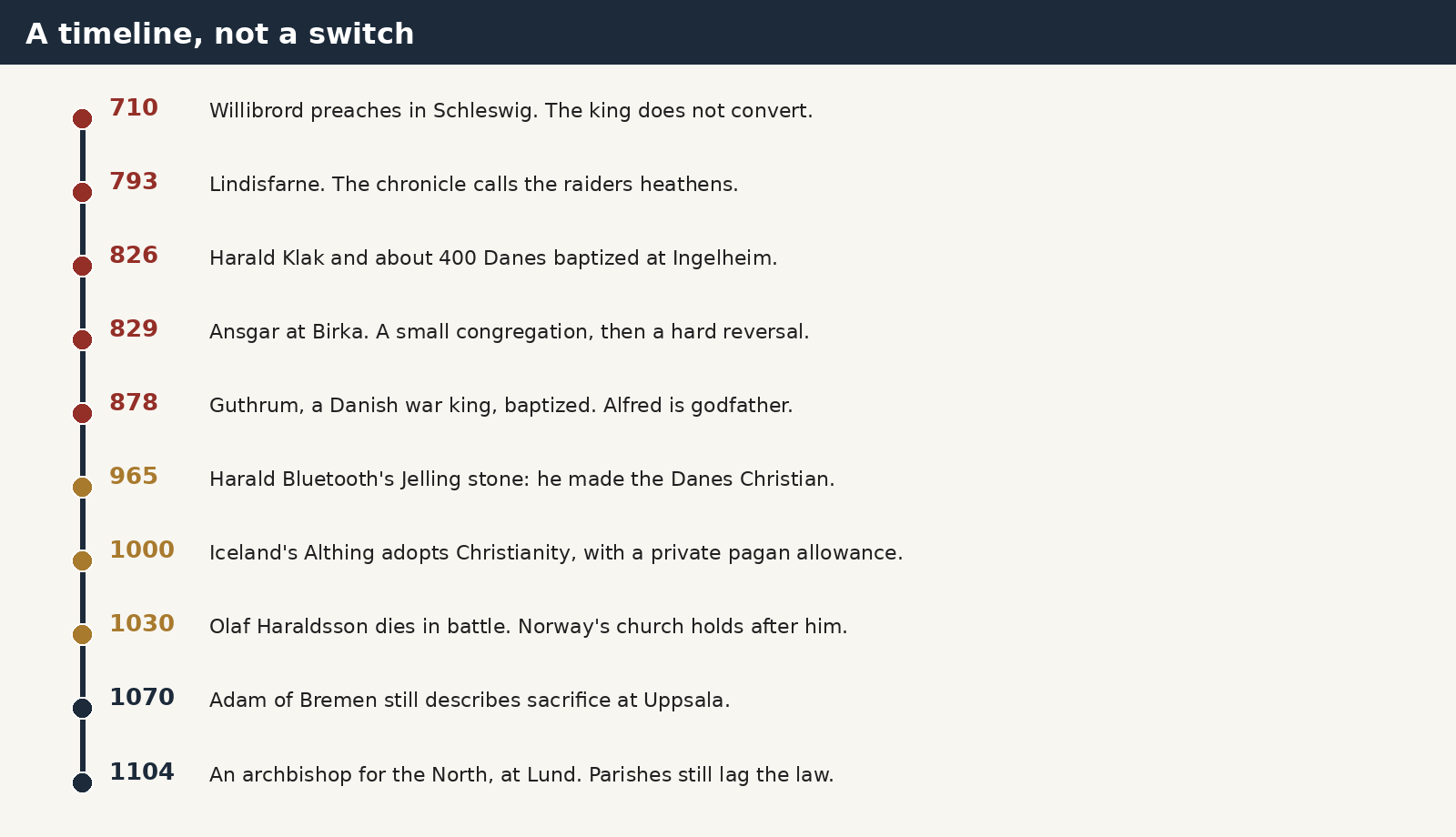
The long middle, in one picture. A timeline, not a switch. Red is the early mission and the early raids. Gold is the royal century, when hammers and crosses share the ground. The dark marks are the late institutional church, after the famous raids, when the old cult is no longer the public law and has not yet left the memory.
What I would not claim
I would not claim the early crews were secret Christians. The first recorded congregations are small, fragile, and often driven out. I would not claim a baptism at a king's court meant the farmer had changed his year. Offerings at springs continued. Churches were built on old holy ground, sometimes from the wood of the old groves. The archbishoprics come late: Lund for the North in 1104, Nidaros in Norway in 1154, Sweden in 1164. Belief in the parishes lagged the law. A Bergen rune from as late as the thirteenth century can still call on a valkyrie. Memory is stubborn.
I also would not claim the missionaries were the only reason the kings moved. Anders Winroth's reading is that Scandinavian kings took Christianity because it was useful to them: one God, one king, a place among the Christian courts, writing, and law. That can sit beside real faith. Harald's stone sounds proud, not merely diplomatic. A political baptism and a convinced one are both in the record. The stone does not tell us which farmers meant it.
And I would not use this lesson to baptize a museum sword, a family story, or a parish we have not opened. This is the history of a culture. It is not a claim about any one house.
A sentence you can both keep
Alyssa, the Viking Age was not born Christian, and most of its early raiders were not Christians. That half of your sentence stands. Paganism was predominant. Anyone who skips that is selling a costume, not a history.
Daniel, the age did not stay pagan, and "no Christian Vikings" is too wide for the men who were baptized, buried with crosses, carved Christ in their own style, and still went to sea. That half stands too.
The honest line is the long one. Paganism was the old religion of the North. Christianity was introduced in writing by the early 700s, planted in towns in the 800s, worn beside the hammer in the 900s, made royal law from about 965 to 1030, and still living next to old habits long after the last famous raid. There were Christian Vikings. They are late, documented, and real. They are not the whole age.
If you want one picture to keep: a hammer and a cross in the same century, a king who boasts in runes that he made his people Christian, and a fleet that did not retire when the king was baptized. That is the culture, early and late. The early half is yours, Alyssa. The late half is the debate. The sources let you hold both without pretending the other is not there.
Sources, so you can check me
I checked this timeline on 6 October 2026 against the standard modern survey of the Christianization of Scandinavia, and against the lives and chronicles that survey rests on. I did not pretend to have sat with the Latin. The dates below are the usual ones in those works. Where a story is a saint's vision or a saga, I have said so.
Alcuin, Life of Willibrord, for the mission of 710 to 718. Rimbert, Life of Ansgar, for Birka, Hedeby, and the congregations of the ninth century. Widukind of Corvey, for Poppo's ordeal and Harald Bluetooth. The larger Jelling stone, for Harald's own claim and the Christ image. The Anglo-Saxon Chronicle, for Lindisfarne in 793 and for Guthrum's baptism in 878. Ari Thorgilsson, The Book of the Icelanders, for the Althing in the year 1000. Adam of Bremen, for Uppsala around 1070. Anders Winroth, The Conversion of Scandinavia, for the reading that kings adopted the faith because it served them. The archbishopric dates, Lund 1104, Nidaros 1154, and Sweden 1164, are the institutional end of the mission, not the end of old habit.
Map tiles are OpenStreetMap. The sketches are original, drawn for this lesson, and labeled as sketches. If a date above is the usual account rather than a stone I stood in front of, I have said "about" or "the usual account." I would rather leave a seam visible than sew the century shut.
With affection for the question, and for both of you.
What people said
Nothing here yet. Go first.